
Designing a bilingual election information platform for Wales

Challenge
Voters struggled to find clear election information because it was scattered across many places. New digital submissions added needed content for the site but also increased workloads for election administrators, candidate teams and website admins.
Action
Led user research, content design and core journey design across across the multi platform service, aligned with GDS standards and Welsh language standards.
Outcome
Delivered a bilingual platform supported by 2 data submission services. Voters have a trusted way to find essential information and provides a scalable foundation for future development of all user journeys
Role | Senior User Researcher / Content Designer / UX Designer
Team | Product Manager / Tech Lead / Business Analyst / Developers
Duration | August 2025 - Current
All images are either royalty free stock or examples images. No imagery is directly from project work to protect privacy
01_Context & Challenge
The introduction of new Senedd reforms required the creation of a single, trusted bilingual election information platform for Wales. Election content previously lived across council sites, PDFs and multiple government sources, with voters unsure which were official. The new system also introduced digital nomination data and manifesto submissions, which would feed key content into the platform and needed to be handled accurately by administrators, candidate teams and website admins.
My role focused on ensuring the service was user-centred, bilingual, accessible and usable across multiple audiences, including voters, electoral administrators and website admins.
The challenges were:
Unifying inconsistent election information from 22 councils and multiple government bodies into a clear, task-focused public service
Designing new digital submission workflows for nomination data and manifestos within an established, time-pressured election ecosystem
Ensuring website admins could accurately review and publish content during a four-week election cycle
Balancing legislative requirements, accuracy and bilingual design while following GDS standards and Welsh Government design principles
I was involved from discovery, through alpha and beta, leading the user research, content design & UX for the public-facing platform and the two supporting data submission services.
02_Process Highlights
-
Discovery
Led 20 user research sessions across the 3 of the 4 key user groups.
Election Services Managers
Voters
Website Admins
Alpha
Led 10 usability research sessions to test core voter journeys and complex content
Delivered a Show & Tell with Welsh Government & EMB board members to showcase the Candidate nomination data import service & Election Address upload service
Beta
Led 10 usability research sessions to test updates to core voter journeys and complex content
Led 10 usability research sessions with Election Services Managers, Election Agents & Website Admins to test their individual services
-
Used research insights to defined a task-first bilingual IA focused on:
how to vote
Choose who to vote for
find out where to vote
submit candidate documentation
find out election results
Structured content types, components and page patterns that worked consistently in both English and Welsh
Removed institutional language and simplified labels to match how voters naturally search
Designed clear flows and copy for sensitive tasks such as:
Candidate statements
Election address review
Used tree-testing insights to iterate towards Alpha testing solution.
-
Designed the voter website, candidate data election address services using GOV.UK-standard components (e.g. forms, file upload, confirmation pages).
Used Welsh Government design principles and system to style screens
Adhered to a muted colour palette and monochrome brand treatment
Delivered high-fidelity prototypes for usability testing and development handoff.
-
Worked through an accelerated agile discovery → alpha → beta process in just 6 months
Collaborated closely with developers, product and stakeholders to shape hypotheses and validate ideas quickly
Adapted journeys, content types and components as regulatory details emerged, maintaining clarity and user focus throughout
03_Major Contributions & Artefacts
Research Plans & Testing Scripts
Purpose | To define a clear and focused research approach across voters, electoral administrators and website admins.
Action | Created a structured research plan covering discovery through beta, coordinating research activities to align with sprint timelines
Impact | Ensured consistent, relevant insight was gathered early, reducing uncertainty and informing IA, content design and workflow decisions.
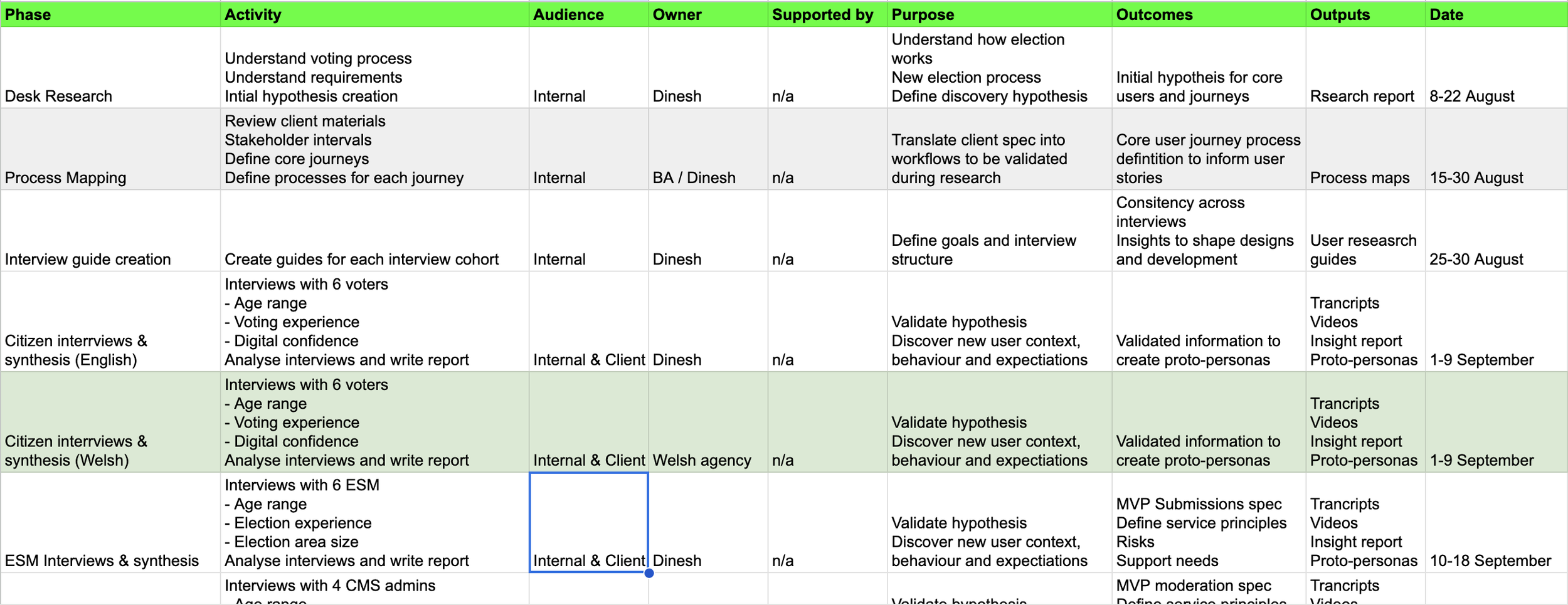
Example template of research plan
Proto-personas
Purpose | Aligned the team on early assumptions about different user groups before validating them through research.
Action | Captured goals, constraints and key behaviours based on initial knowledge, before validating in discovery interviews.
Impact | Provided a shared understanding across the team and helped focus discovery on the most important user needs.
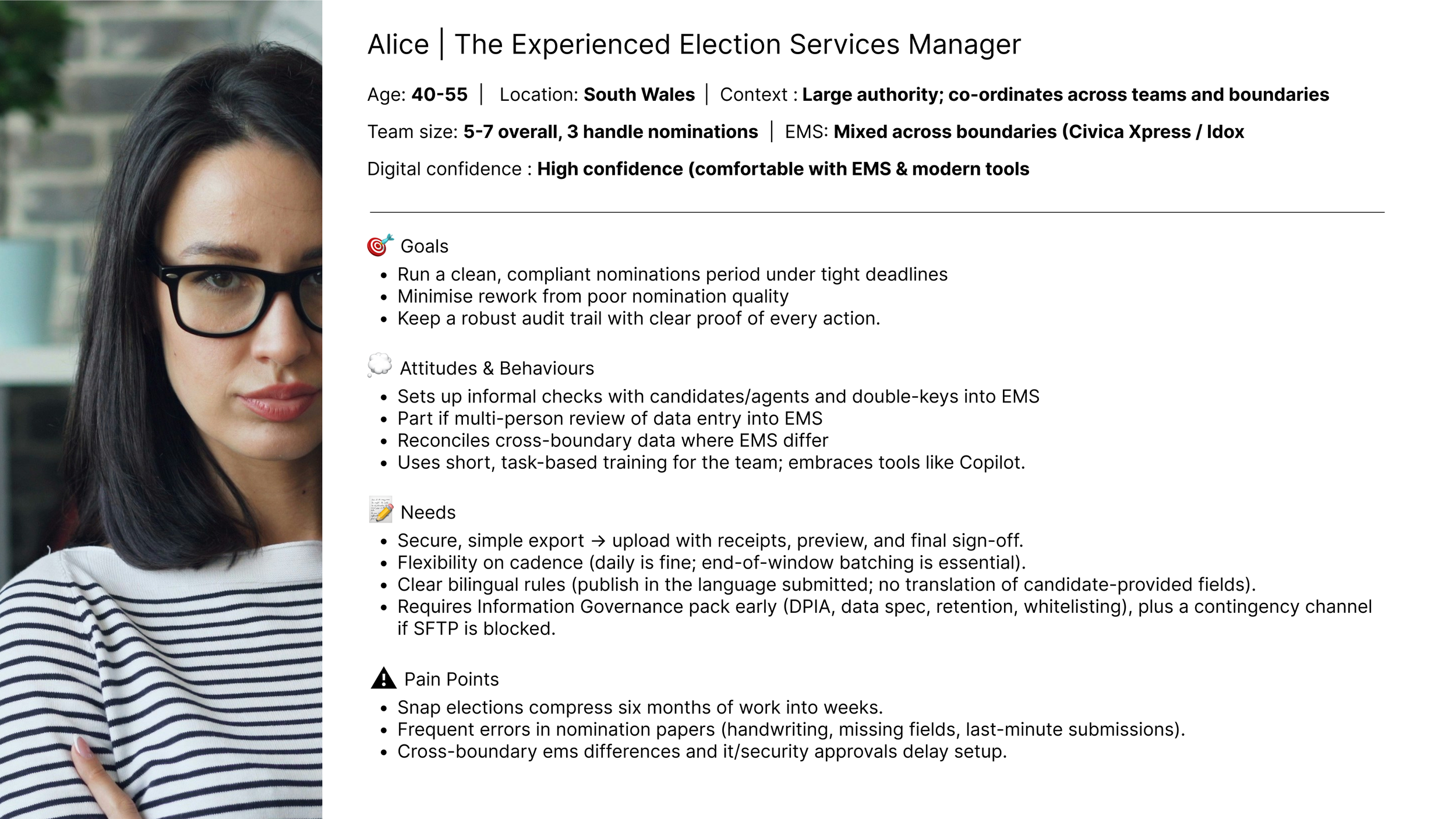
Example of a proto-persona
Information Architecture
Purpose | Create a task-first, bilingual structure that simplified how users find election information.
Action | Through an iterative approach, designed a simple bilingual IA centred on key voter tasks
Impact | Reduced publishing risk during high-pressure election periods and enabled website admins to work more confidently and efficiently.
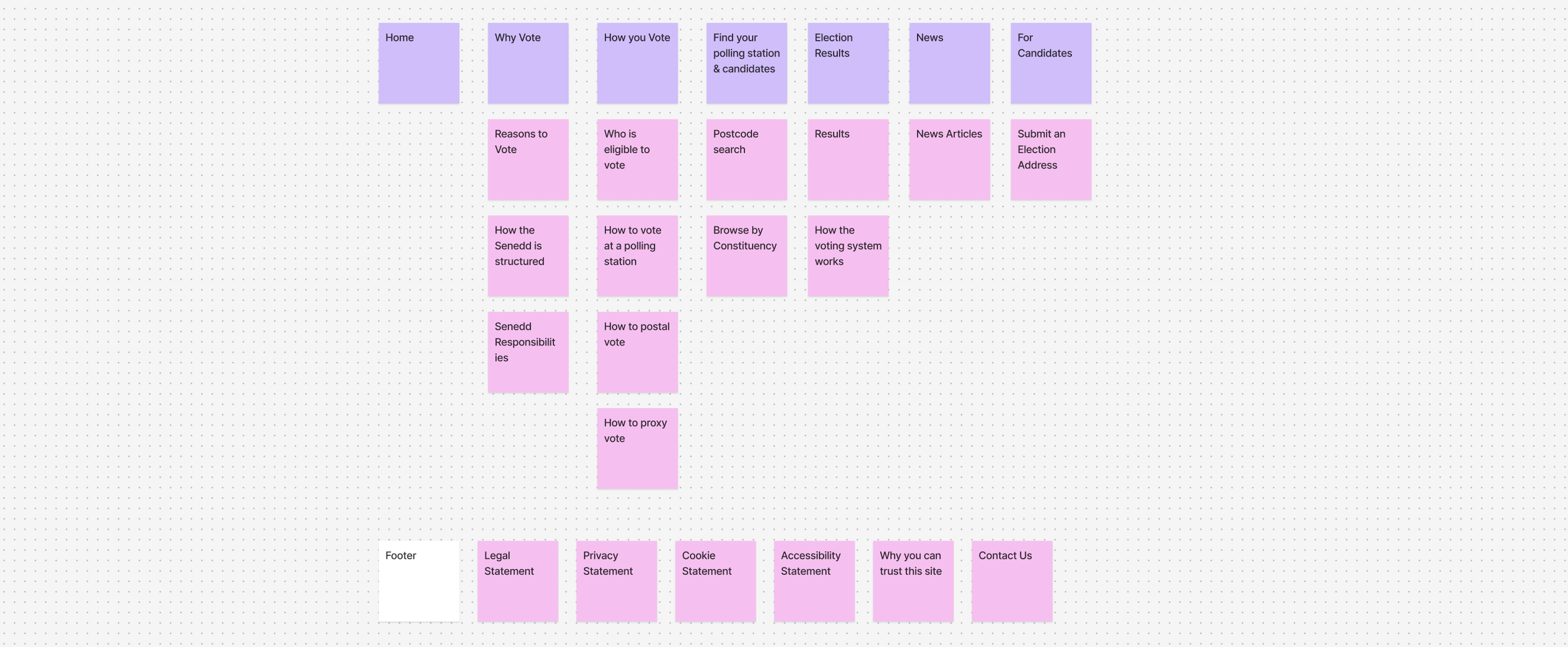
A version of the information architecture
Content Type Definition
Purpose | Structure election information into reusable, consistent content types that support both public users and internal workflows.
Action | Defined content types across all systems, mapping how content would be created, reviewed and published bilingually.
Impact | Reduced publishing risk during high-pressure election periods and enabled website admins to work more confidently and efficiently.
UX/UI Prototypes (GDS patterns)
Purpose | Explore, test and communicate how the service would work for voters, contributors and internal users.
Action | Produced wireframes for all key journeys across systems, and page templates that worked consistently across languages
Impact | Supported usability testing, stakeholder alignment and faster iteration across discovery, alpha and beta.
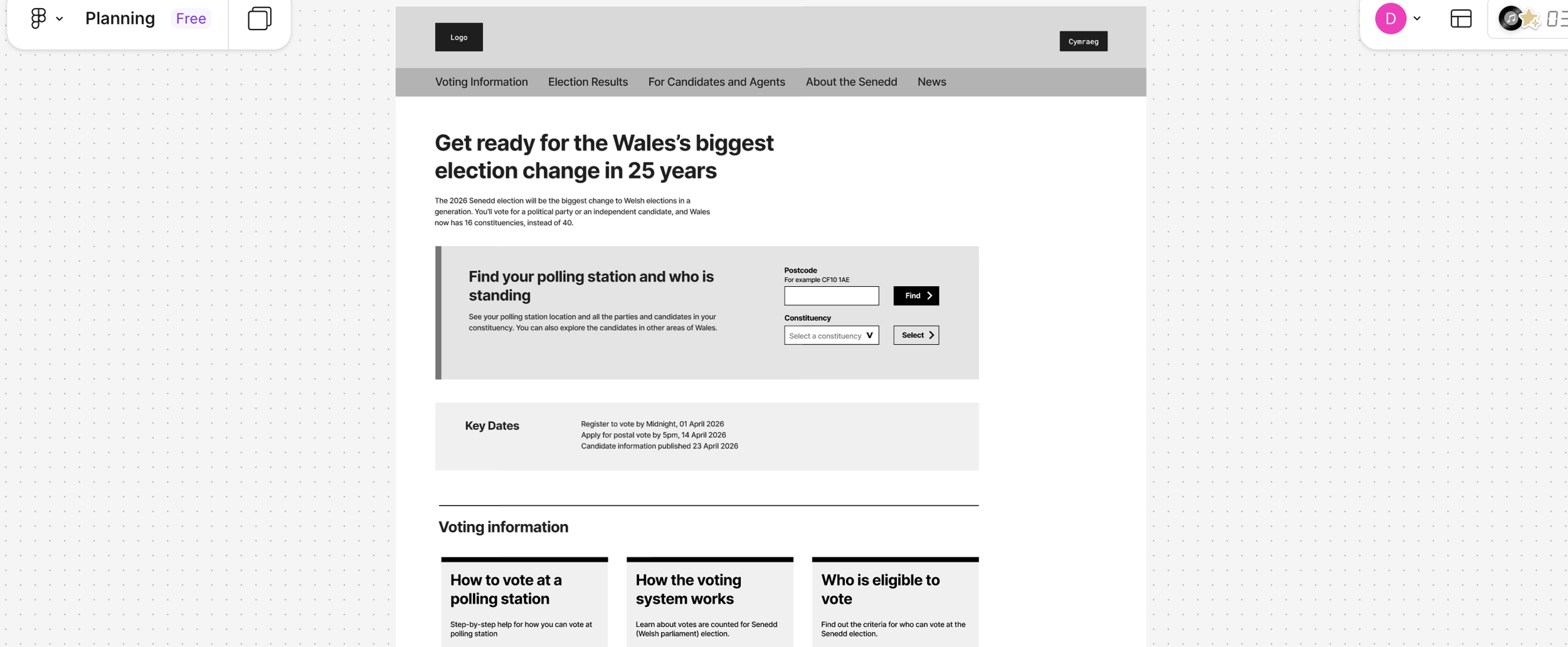
Example wireframe utilising GDS components
Design Support During Delivery
Purpose | Ensure research and design intent translated clearly into build-ready user stories and tickets.
Action | Worked closely with the business analyst to clarify user needs and edge cases to help define user stories. Supported developers during build to resolve questions quickly
Impact | Reduced rework and improved delivery speed and confidence, particularly within tight project timeline.
04_Pre-launch outcomes
The bilingual public platform and two supporting data submission services are complete in beta and ready for handover to internal teams in March
The task-first structure, navigation and page patterns are agreed across stakeholders and support voter needs before, on the day and after an election, in both English and Welsh
Internal teams have clear workflows, content structures and guardrails in place to support submission, review and publishing during the four-week election cycle
Public go live is planned for April
05_Reflection & next steps
What worked:
Running research early helped align stakeholders and reduce late changes during a tight election timeline
A task-first IA and clear content structures made it easier to design and agree bilingual journeys
Close collaboration with the business analyst and development team helped designs translate cleanly into delivery
Next steps:
Post-go-live monitoring to understand how voters use the service before, on the day and after an election
Gather feedback from election teams on data submission and review workflows during live use
06_Key takeaway
Supporting internal teams as well as end users is critical to delivering clear, trusted public services.